
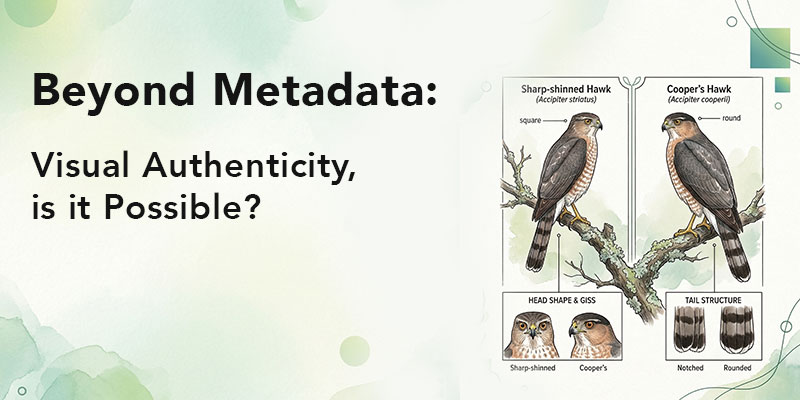
Originally featured on DAM News, this new article called Beyond Metadata: Visual Authenticity, is it Possible? by Paul Melcher explores a deep question: can authenticity be conveyed purely through visual language? And more importantly, can audiences feel trust before they consciously verify it? In a digital ecosystem flooded with AI-generated content, traditional signals of trust—badges, checkmarks, and logos—may no longer be enough.
Melcher argues that true visual authenticity is rooted not in static identifiers, but in something far more human: consistency, evolution, and character. Drawing on concepts like GISS (General Impression of Size and Shape), he outlines how brands can build instinctive recognition through a cohesive visual identity that behaves more like a personality than a system.
This piece offers a compelling look at how brands can build trust in an era where visual content is increasingly easy to replicate. As AI continues to blur the lines between real and synthetic, the brands that stand out will be those that develop a distinct visual character—one that audiences recognize instinctively.
Below is an excerpt from the article by Paul Melcher:
Can we use visual signals to convey trust? Can we use visual elements to communicate authentic provenance?
We know about trust symbols, the checkmarks, the badges, the verified icons. But insert these into an ad or marketing campaign, and they do little to convince viewers that what they’re seeing is trustworthy. In fact, they can sometimes have the opposite effect. A trust badge screams “you should doubt this” as much as it promises verification. So how do we generate trust using only visual signals, without resorting to explicit markers that can be easily copied or ignored?
Trust Requires Provenance
To initiate trust, we need to be convinced that what we’re seeing, the message being communicated to us, comes from a trusted source. For marketing, that means the brands we know and trust. So trust is inextricably linked to provenance. If we are sure beyond a doubt about the source of the communication, we can trust it. To convey trust, we need to assert provenance.
Obviously, logos come to mind as the visual communication tool to affirm provenance. But logos can be easily forged, replicated. While they have to be there, they are the minimum indispensable layer—necessary but not sufficient.
We need other tools.
Building Visual Language Over Time
Over time, successful brands have learned to create a visual language that is unique to them. Think of Nike, Apple, Supreme. You can immediately picture a feel and tone that is unique to them, along with very specific messaging. That’s because over time, they have successfully built, along with building trust, a particular set of rules by which they communicate. A bit like creating a persona. And since we as humans trust people, that makes sense.
The trick to using visual cues to establish trust is to create a visual relationship that behaves like a predictable, immediately recognizable human being.
Read the full article on DAM News to explore the complete perspective.