The Great Reconnection: Why 2026 Will Be the Year of the Pipe
by
Paul Melcher
If 2025 was the year of the “Pilot,” 2026 is shaping up to be the year of the “Pipe.”According to the just-released Martech for 2026 report, a staggering 90.3% of marketing organizations are now using AI agents, with Content Production emerging as the #1 use case at 68.9% adoption. Yet only 23.3% have successfully moved these agents into full production. The vast majority are stuck in “pilot purgatory,” blocked by Data Quality (56.3%) and Integration Friction (50.5%).Meanwhile, the Visual & Design Marketing Trends 2026 report reveals a creative workforce with a different set of anxieties: 27% of creative teams struggle specifically with “maintaining the brand look” as automation speeds up. The fear of off-brand content is rising faster than the automation itself.What’s emerging is a pretty clear picture of 2026: it’s not going to be about better AI. It’s going to be about better infrastructure, specifically the connections between the ops world and the creative world.
The “First Mile” Problem
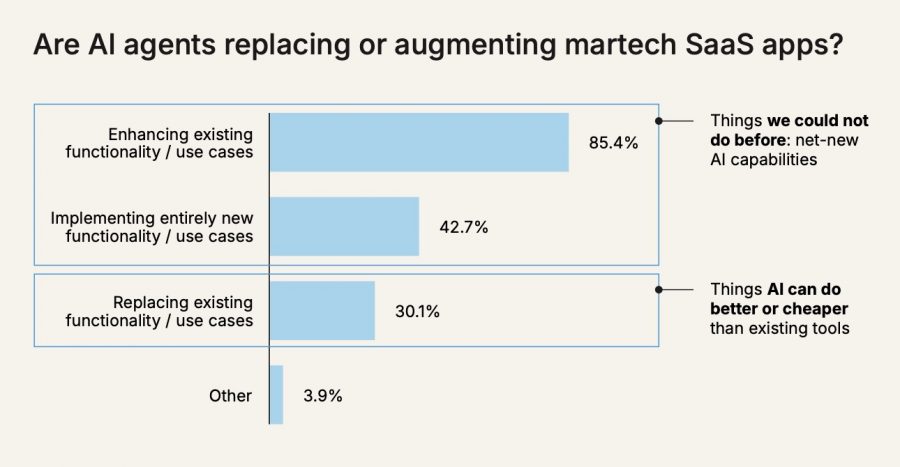
“Context engineering” is now being identified as a core competency. The idea is that AI agents need the right data to make good decisions, and you can’t fake that after the fact.But most DAM strategies still focus on the “last mile”: someone uploads an asset, and a librarian tags it later. That worked fine when you had 100 assets a month. It breaks completely when you’re generating 1,000 variations a week.The shift is straightforward: capture context where it’s created, not where it’s stored. When a designer is working in their creative tool, they know where the asset is from, for whom it was requested, and what the constraints are. Connecting the creative environment directly to the infrastructure (as LinkrUI does with Creative Cloud and DAMs) means that context is captured and preserved, automatically, as a byproduct of the work itself.And with more and more legislation requiring transparency in content origin arising, this is no longer an option.AI is not replacing but rather augmenting both human and existing tools. Credit Martech for 2026 report
The Hybrid Reality
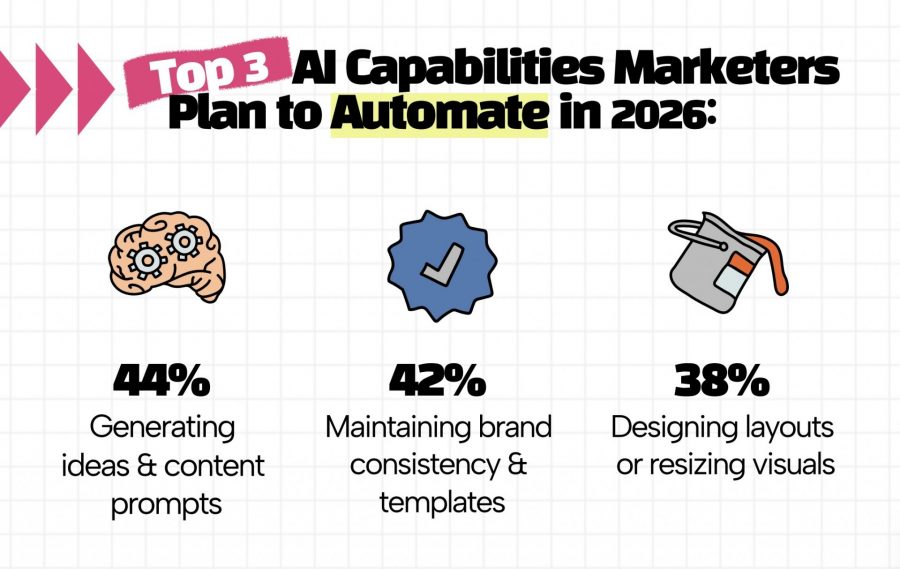
The visual trends data gets specific about what designers actually want: 38% want to use AI for automated resizing and formatting, while 36% want to keep ideation strictly human. They’re not asking for full automation. They’re asking for a precise division of labor; machines handle the tedious mechanical work, humans handle the creative decisions.This matters because it suggests a design pattern for 2026 tools: build for “emotion checkpoints.” Moments in the workflow where a human validates what the machine is doing. The designer stays in their cockpit (the software they know), while the infrastructure handles logistics in the background.
Solving the “Speed vs. Quality” Paradox
Perhaps the most critical finding for 2026: 39% of teams say “Speed with consistent quality” is the #1 differentiator for high performance. Historically, those were trade-offs: fast and messy, or slow and perfect.But in AI-driven workflows, governance is actually what enables speed. If a creative team trusts that their connector will only serve approved, rights-managed assets, they design faster. If a brand manager trusts that their automation tool creates variations locked to a brand kit (like BannersUI does), they approve faster.This directly addresses the 27% of teams struggling to maintain brand consistency. The answer isn’t slowing down. It’s building systems where brand standards are encoded into the infrastructure itself, so automation can’t produce off-brand work even when nobody’s watching.Building with AI, yes, but with human oversight. Credit Visual & Design Marketing Trends 2026 Report by Venngage
The Absence in the Data
But here’s something worth noting: neither of these surveys asks about ethics, values, transparency, copyright protections, or trust infrastructure.The focus is entirely on efficiency: faster pipes, better data, smoother workflows. All are critically important. But as organizations build connected systems that can automatically generate hundreds or thousands of assets, there’s an open question about what else should flow through those pipes.Provenance. Attribution. Guardrails about what AI can and can’t do with source material. Audit trails that survive automation.It’s not that these questions have answers yet. But 2026 might be the year the industry starts asking them seriously, because the infrastructure that makes everything fast is the same infrastructure that needs to make everything accountable.
What Comes Next
The consensus from both reports is clear: infrastructure is the bottleneck. The winners in 2026 won’t be the companies with the best AI models. They’ll be the companies with the best connections: the ones who figured out how to link the factory (martech ops) to the studio (creative production) without breaking either one.But there’s a foundation question underneath all of this: as we build systems that can generate content at scale, what values are we encoding into that infrastructure? Respect for the work humans create. Clear ownership. Transparency in how automation makes decisions. These are part of what makes infrastructure trustworthy enough to use at speed.At Santa Cruz Software, that’s what we’re building toward. Not just tools that move files faster, but systems that preserve intent, capture context, and let AI handle the mechanical work while keeping humans in charge of the creative decisions, and the ability to explain how those decisions get made.